New Delhi, Sep 1: The Ashoka Centre for Translation, part of the Harish and Bina Shah School of Humanities, in partnership with The New India Foundation, concluded the third edition of Bhashavaad: National Translation Conference on August 30, 2026 bringing together renowned writers, translators, publishers, scholars and practitioners for two days of conversations on the future of translation, Indian languages, and literature amid rapid technological and cultural change.
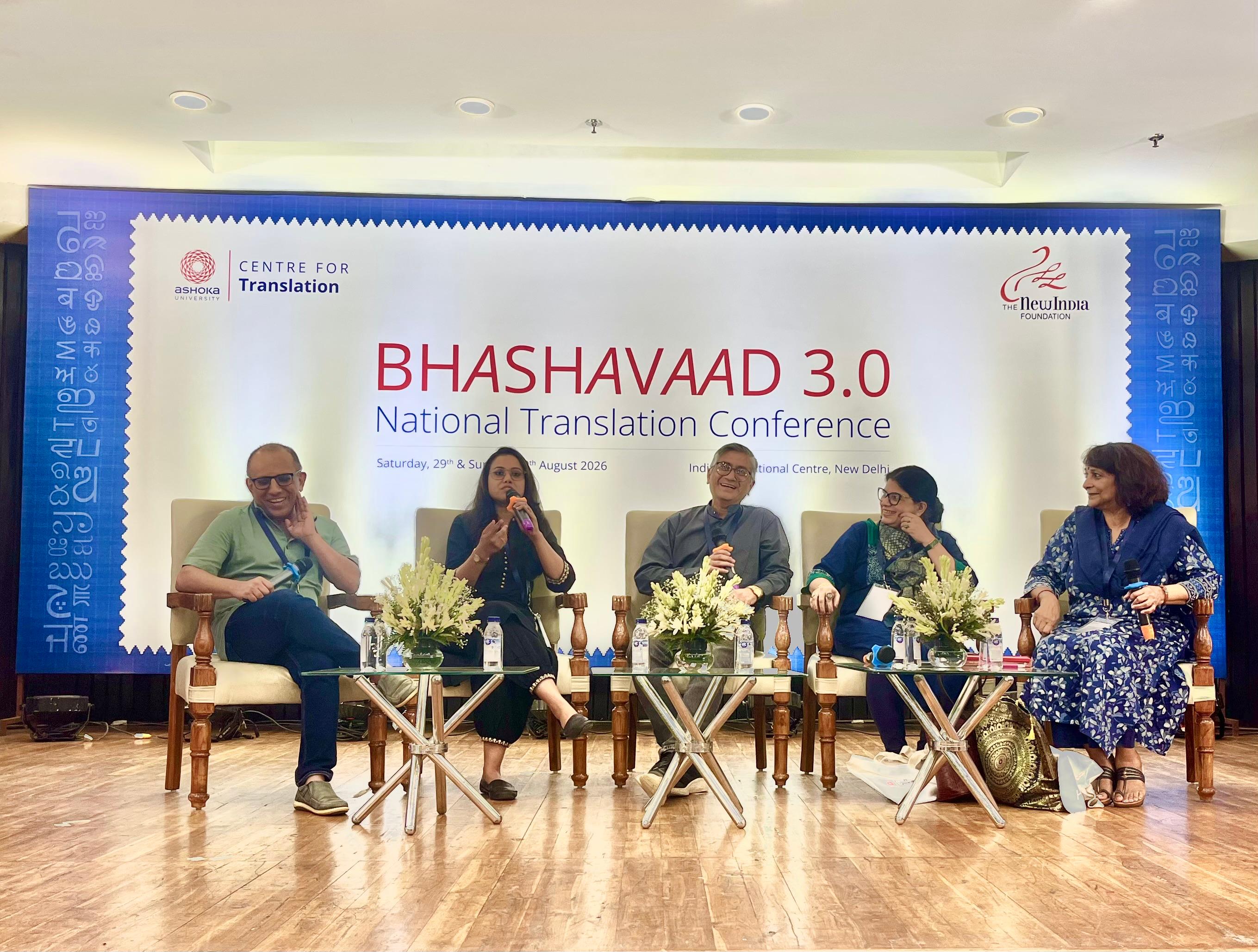
A central theme of this year’s conference was the growing influence of artificial intelligence on translation, writing and publishing, alongside discussions on multilingualism, Indian literary traditions, reading cultures and the need to bring diverse voices, oral traditions and languages into wider literary discourse.
The two-day conference featured leading names from the literary and publishing ecosystem, including Nishat Zaidi, Simona Sawhney, Volga, Salma, Anita Bharti, Rakhshanda Jalil, Chiki Sarkar, Urvashi Butalia, among several distinguished translators, publishers, scholars and practitioners working across Indian languages.
Day 2 began with a presentation of ACT-IDAF Fellowship for Research into AI Translation from Malayalam, examining the capabilities and limitations of AI in literary translation. The study found that while AI could respond effectively to targeted, context-specific human guidance, its outputs continued to require significant human intervention and editorial judgement, particularly when it came to accurate representation and preservation of the literary, cultural and psychological texture of the original work.
This was followed by an engaging panel ‘Being Indian, Being Modern’, moderated by Urvashi Butalia, Feminist, Publisher and Writer, featuring J Devika, Banani Chakravarty, Anita Bharti and Rakhshanda Jalil. The all-women panel examined questions of Indian identity and modernity through the lens of language, literature and lived experience, with the speakers reflecting on plural identities, marginalised voices and the different meanings of modernity across regions and communities.
Reflecting on the discussion, Urvashi Butalia highlighted how questions of modernity and marginalisation are often deeply intertwined, particularly for women and those working with marginalised languages and identities. She cautioned against allowing dominant voices to define the terms of the conversation, saying, “We should not be in a hurry to allow gatekeepers to decide what concepts such as modernity mean, or whose languages and voices are allowed to matter.” She pointed to the ways in which dominant narratives can push certain languages, communities and perspectives to the margins.
The conversation then turned to voices that remain less represented in mainstream literary discourse through ‘An Unanswered People’, featuring Kanji Patel, Ramesh Karthik Nayak, Malsawmi Jacob and Parwati Tirkey in conversation with Kamalakar Bhat. Drawing from an anthology of contemporary Adivasi poetry, the session explored the diversity of Adivasi languages and literary traditions while questioning the tendency to view Adivasi writing primarily through the lenses of marginalisation. The speakers also reflected on the role of translation and the preservation of languages and scripts in bringing greater visibility to these literary traditions.
One of the key sessions of Day 2, ‘Writing and Publishing in the Age of AI’, brought together Karthika VK, Chiki Sarkar, Arunava Sinha and Debayan Gupta in conversation with Rahul Matthan. The discussion examined how AI is already reshaping the processes of writing, translation and publishing, with the speakers reflecting on its potential to improve efficiency, expand access and support creative work, while also raising questions about authorship, creativity, originality and the changing economics of publishing. Chiki Sarkar, Founder, Juggernaut Books challenged the idea that AI and creativity exist in opposition, noting that the technology is already being actively used across the publishing process, from editing and reviewing manuscripts to generating ideas and supporting illustration. “The tension between AI and creativity is a false one,” she said, emphasising that AI remains a tool directed by human imagination and judgement.
On the opening day, Rita Kothari and Arunava Sinha, Co-Directors of the Ashoka Centre for Translation, reflected on translation as a vital expression of India’s multilingualism.
Rita Kothari, Co-Director, Ashoka Centre for Translation, said, “Translation is not simply a solution to the problem of multilingualism. In India, it is its manifestation, its expression and its site. Translation is at the foundation of civilisations and has shaped the movement of ideas, cultures and texts across time. Bhashavaad is a space where we discover not only translators, but also what translators and translation discover for us.”
Adding to this, Arunava Sinha, Co-Director, Ashoka Centre for Translation, said,
“In the process of translating books which the Ashoka Centre for Translation has set out to do, the one thing we have discovered is that the literatures of India, which existed in their diversity as ideas only, are actually far richer, far deeper and far more diverse than we could have imagined.
Translation is the medium through which we can enter one another’s languages and literatures. Our hope is that every centre of literature in India can use translation to take its stories and ideas to readers beyond its own language and linguistic boundaries.”
The first day featured a keynote address, ‘Translation, Mimesis, Aphasia’, by Simona Sawhney, Professor of Literature, IIT Delhi, who reflected on translation as an act that moves beyond simple reproduction or equivalence, exploring how meaning is reshaped as it travels between languages. She said,
“Translation is not about finding a perfect substitute for one language in another. It is about the encounter between languages, about what can be carried across, what is transformed in the process, and what cannot be reproduced at all.”
The conference also explored the relationship between writers and translators through ‘The Writer and Her Translator’, featuring Volga, Purnima Tammireddy, Salma and GJV Prasad in conversation with Nandini Nair. The session examined the role of trust, interpretation and collaboration in carrying literary works across languages.
Another key discussion, ‘Are Translators Redundant?’, featured Poonam Saxena, Murali Ranganathan, Moutushi Mukherjee and Nishat Zaidi, in conversation with Arunava Sinha. The panellists examined the growing role of AI in translation, acknowledging its potential to support translators and improve efficiency while emphasising the distinctly human dimensions of literary translation, particularly the interpretation of cultural context. The conversation also raised questions around ethics, copyright and the evolving responsibilities of translators, editors and publishers as AI becomes increasingly embedded in the literary ecosystem.
The session ‘What Is India Reading?’, featuring B Srinivasan, Semanti Ghosh and Jayant Mammen Mathew in conversation with Manish Sabharwal, Co-founder, Teamlease Services and Ashoka University, turned attention to India’s reading landscape and the ways in which literary consumption is evolving.
Across two days, Bhashavaad 3.0 created a platform for sustained conversations on the changing landscape of translation, India’s evolving reading culture and the future of publishing, while highlighting both the opportunities and challenges presented by artificial intelligence.
The Ashoka Centre for Translation also showcased its expanding body of work, including publishing initiatives such as Women Translating Women and Chronicles, as well as upcoming collaborations and new initiatives aimed at taking Indian literature and ideas to wider audiences.