
– by Akash Pharande, Managing Director – Pharande Spaces:
For several decades until fairly recently, marble lobbies, imported fixtures, and sweeping views of the city or landscaped parks, gardens and sometimes reserved forests were the hallmarks of luxury in Indian real estate. This definition has rapidly evolved since the Covid-19 pandemic and recent global warming statistics have redefined comfort, health, and responsibility.
Today, luxury homes must tick several new boxes for affluent buyers who have travelled the world and are very aware of climate risks. The trend of eco-luxury housing has taken firm root in India, changing the basic idea of what it means to live in luxury. Modern integrated townships follow this design philosophy as a matter of course.
Where It Began
This trend can be traced back to factors that came together during the pandemic years. Indians suddenly spent more time at home than they had ever hoped or planned, becoming acutely aware that air quality, natural light, thermal comfort, and proximity to green spaces are actually very important.
And, of course, India’s urban infrastructure problems – water shortages, power outages – and extreme heat events had already shown us how weak regular luxury is. An apartment with a designer kitchen but no way to collect rainwater suddenly looked like an argument that began well but then remained incomplete.
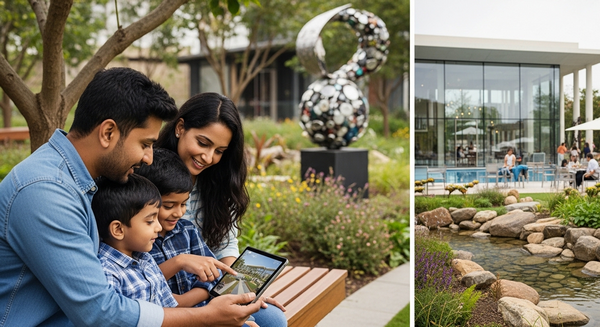
Meanwhile, HNIs and NRIs who had lived in LEED-certified buildings in Singapore, London, or Dubai came back with very clear expectations. ESG credentials, biophilic design, and verifiable sustainability metrics are all normal in those markets. India’s government started pushing developers to build more environmentally friendly buildings by making building codes stricter, offering green FAR incentives, and supporting certifications like IGBC and GRIHA.
This was all part of India’s goal to reach net-zero emissions by 2070. In other words, market and mandate aligned almost perfectly to create the perfect stage for eco-luxury as the responsible way to announce your social ‘arrival’ without compromising on superior creature comforts.
What Eco-Luxury Really Means
Let me first state what it is not: putting solar panels on a regular tower as an afterthought is neither luxury nor eco-luxury. What it really is – a design philosophy that weaves sustainability into every part of a luxury project, from its orientation and glazing to how the microclimate and the community’s water systems are managed.
At a minimum, an eco-luxury home today must have:
– IGBC or LEED green certification
– Robust rainwater harvesting and waste water treatment systems
– Solar power generation for common areas and even individual units
– EV charging stations incorporated
– Biophilic design with vertical gardens, natural ventilation and lots of natural light
– Smart metering to manage energy and water
– Smart air filtration systems, non-toxic finishes, acoustic design, and access to curated green open spaces
These are now considered standard features of eco-luxury – not ‘extra’ wellness and sustainability talking points for the brochures. Luxury townships following the eco-luxury blueprint generally do not advertise these details, as they are expected to have them as a matter of course.
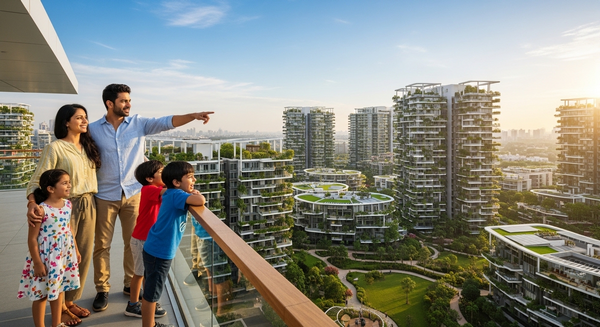
How Appealing is The Eco-Luxury Township Lifestyle?
The appeal is broad, but it works best for three types of buyers. Young high-net-worth individuals in the tech sector, usually between the ages of 35 and 50, see green credentials as a sign of smart, future-proof design. NRIs, who invest USD 14 billion a year in real estate, are used to sustainability benchmarks as a standard in mature global markets.
And women who make decisions about buying luxury products – including homes – now have significantly more market power than they did in bygone years. Women HNIs ALWAYS put health, wellness, and environmental responsibility first when choosing a home.
While aspiration for the eco-luxury township lifestyle has never been higher in India, there is also cold pragmatism behind the rise of this important new evolution of the luxury housing story. In cities like Pune and Bengaluru, where water is hard to come by and electricity costs are high, a home with certified water recycling and solar integration delivers less volatile utility bills. This is a very real luxury for homebuyers who value predictability as much as prestige.
Costs for Developers and Buyers
Building a township to eco-luxury standards involves notably higher construction costs. Fees for IGBC certification for a large residential project is relatively modest at around INR 3 lakh, but the infrastructure investment in solar panels, STPs, smart metering, and green landscaping adds a lot to the project’s overall costs. An IGBC Gold-certified 3BHK in a major Indian city costs anywhere between Rs. 10-20 lakh more than a similar unit in a project that doesn’t have such certification.
But the operational savings are equally significant, and, apart from the considerable bragging rights, Indian HNIs focus more on this aspect. A typical eco-luxury 3BHK unit saves the resident between Rs. 30,000 and Rs. 50,000 a year on utilities alone. This amount compounds significantly over a 10–15-year holding period. The extra cost at the start will pay for itself over time.
This is where the eco-luxury rationale becomes financially interesting for investors, because homes that are green-certified sell for anywhere between 10-20% more in the major Indian cities. IGBC-certified properties are increasing in value by 12–15% each year, while similar non-certified luxury units are only seeing 9–11% annual price growth. This 3–4 percentage point difference adds up handsomely over five to seven years.
Eco-luxury homes also rent out for 12–15% more than regular luxury homes, and they have vacancy rates of less than 5% (compared to more than 10% for regular premium housing). Rental yields in the luxury market are between 3.5% and 4%, which is better than the 2% to 2.5% that is common for mid-market homes. Eco-luxury generates an internal rate of return that is equal to or higher than that of traditional commercial real estate in many markets when combined with stronger appreciation.
The Eco-luxury Investment Case in Simple Terms
The eco-luxury buyer is not giving up anything by being friendly to the environment. They are getting an asset that is better for the environment, easier on their wallets and conscience, and worth a lot more on the resale and rental market. Green certification is quickly going from something that sets developers apart to something that is required for most projects.
