New Delhi, July 15: Reinforcing India’s commitment to becoming a global semiconductor powerhouse, PHD Chamber of Commerce and Industry organised “SEMICONDUCTOR INDIA 2026 – National Conference on Accelerating India’s Semiconductor Sovereignty” at PHD House, New Delhi. The conference brought together senior government officials, industry leaders, academia, skilling institutions, MSMEs, startups and technology experts to deliberate on strengthening India’s semiconductor ecosystem through policy, manufacturing, innovation, skilling and strategic collaboration.
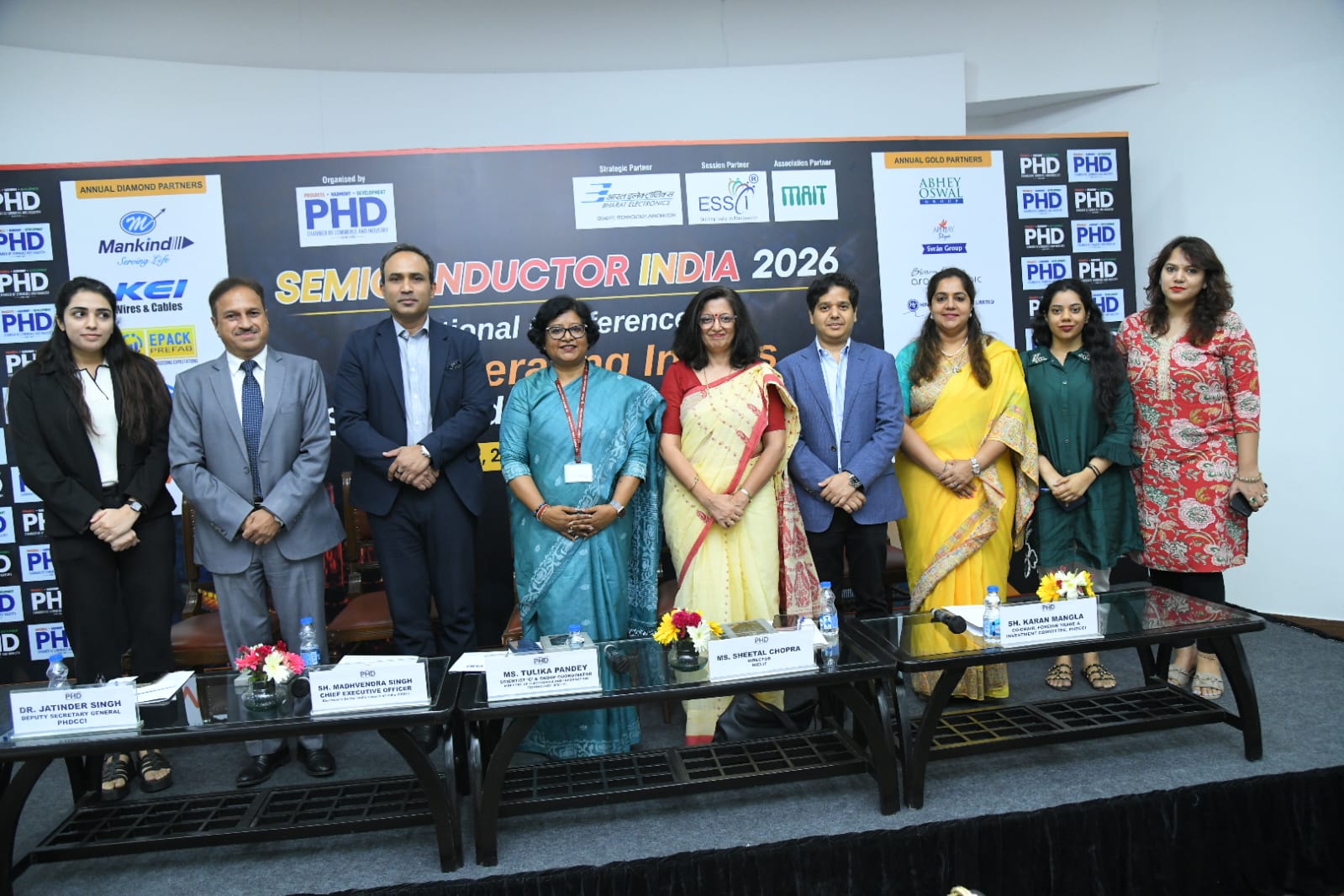
The conference was graced by Ms. Tulika Pandey, Scientist ‘G’ & Group Coordinator, Ministry of Electronics and Information Technology , Government of India, as the Guest of Honour. Shri Madhvendra Singh, Chief Executive Officer, Electronics Sector Skills Council of India ; Ms. Sheetal Chopra, Director, National Institute of Electronics and Information Technology , MeitY, as the Special Guests and other esteemed panelists from the industry and academia.
Addressing the august gathering, Ms. Tulika Pandey highlighted that semiconductor sovereignty today extends beyond manufacturing capabilities to encompass trusted technologies, resilient supply chains, secure digital infrastructure and indigenous innovation. She emphasised that the Government of India, through the India Semiconductor Mission and the recently announced ISM 2.0, is creating a comprehensive ecosystem covering semiconductor design, fabrication, packaging, testing, research, innovation and advanced manufacturing. Calling upon industry to transition from technology adopters to technology creators, she stressed the need for greater participation in global standards, advanced materials, emerging technologies and ethical innovation. She further highlighted that MSMEs, startups and innovators will play a defining role in shaping India‘s semiconductor future and reiterated that close collaboration between government, industry, academia and the skilling ecosystem is essential to realize the vision of Viksit Bharat 2047.
Highlighting the critical role of talent development, Ms. Sheetal Chopra stated that human capital remains India‘s greatest strategic advantage in the global semiconductor landscape. She noted that while fabrication facilities and manufacturing investments are important, India‘s long-term competitiveness will depend on building a highly skilled workforce capable of contributing across the semiconductor value chain from the very first day. She highlighted NIELIT’s expanding role in strengthening India‘s semiconductor talent ecosystem through its nationwide network of 56 centres, specialised programmes in semiconductor design, VLSI, embedded systems and emerging technologies, along with flagship initiatives such as the Centre of Excellence in Chip Design, Noida, the e-Chip Hub national learning platform and upcoming Centres of Excellence in Assam and Gujarat. She emphasised that democratising access to advanced technology education across Tier-II, Tier-III cities and aspirational districts will be instrumental in creating a globally competitive semiconductor workforce.
Shri Madhvendra Singh emphasized that semiconductor sovereignty has become a strategic imperative for India‘s economic growth and national security. He noted that India‘s semiconductor ecosystem is witnessing unprecedented momentum with 13 approved semiconductor projects, cumulative investments exceeding USD 20 billion, and a domestic semiconductor market projected to reach nearly USD 130 billion by 2030. He highlighted that this rapid expansion would require nearly 400,000 semiconductor professionals and approximately 1.5 million skilled workers across the broader semiconductor value chain. Stressing that MSMEs will be the backbone of component manufacturing, testing, packaging and precision engineering, he highlighted ESSCI’s initiatives in developing industry-aligned occupational standards, specialised curriculum, Centres of Excellence, apprenticeship programmes and faculty development to create a globally competitive semiconductor workforce.
Presenting the industry’s perspective, Shri Karan Mangla, Co-Chair, Foreign Trade & Investment Committee, PHDCCI, and Promoter & Director, S H Haryana Wire, stated that India has made remarkable progress in establishing the foundations of a robust semiconductor ecosystem through the approval of 13 semiconductor projects under the India Semiconductor Mission and the rollout of ISM 2.0. He emphasised that the country’s next priority must be to translate policy momentum into large-scale manufacturing by accelerating infrastructure development, ensuring cleanroom readiness, strengthening power and water infrastructure, and streamlining regulatory approvals. Stressing that semiconductor sovereignty cannot be achieved without a resilient domestic supply chain, he highlighted the indispensable role of MSMEs in component manufacturing, specialty materials, precision engineering, cleanroom consumables and allied industries. He further called for dedicated vendor development programmes, stronger industry-academia collaboration, manufacturing clusters and demand-side support to enable Indian enterprises to emerge as globally competitive players in the semiconductor value chain.
Welcoming the distinguished delegates, Dr. Jatinder Singh, Deputy Secretary General, PHDCCI, stated that semiconductors have emerged as the foundation of economic resilience, technological leadership and national security amid evolving geopolitical dynamics and global supply chain realignments. He said the conference was conceptualised to provide a common platform for policymakers, industry, academia and MSMEs to develop a shared roadmap for indigenous semiconductor design, fabrication, packaging and advanced manufacturing while identifying critical gaps in skilling, infrastructure and investments. Stressing the indispensable role of MSMEs in the semiconductor value chain, he said PHDCCI remains committed to supporting industry through policy advocacy and stakeholder engagement.
The conference also featured two high-level technical sessions titled “Building India‘s Semiconductor Workforce: ISM 2.0 Training Mandate & Industry-Ready Talent” and “From Policy to Production: ISM 2.0, Manufacturing Scale-Up & Indigenous Design.” The sessions witnessed extensive deliberations on semiconductor manufacturing, indigenous chip design, talent development, advanced packaging, research and innovation, investment opportunities, MSME integration and supply chain resilience. Experts emphasised that sustained collaboration among government, industry, academia, research institutions and startups will be crucial for positioning India as a trusted global hub for semiconductor design, manufacturing and innovation.
The conference concluded with a strong consensus that India‘s semiconductor ambitions must be driven by policy stability, accelerated investments, world-class infrastructure, a robust skilling ecosystem and a vibrant MSME network. Participants reaffirmed that by combining indigenous innovation with strategic partnerships and talent development, India is well-positioned to emerge as a leading global destination for semiconductor manufacturing and technology, contributing significantly to the vision of Atmanirbhar Bharat and Viksit Bharat 2047.