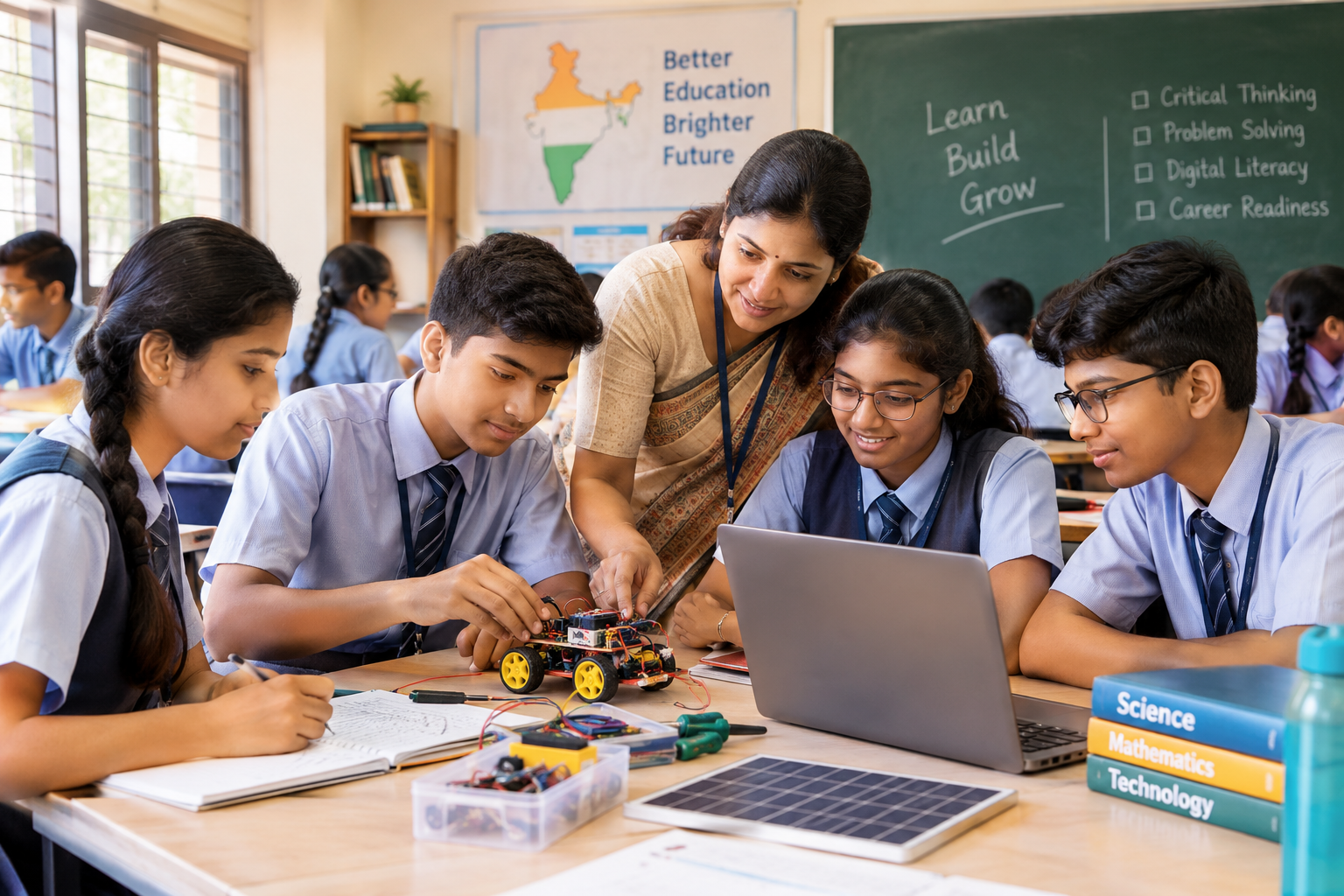
Oct 16: India has made significant progress in expanding access to education, but getting children into school is only part of the challenge. What they learn, the resources available to them and the opportunities they receive can shape their future in very different ways.
Consider two students preparing for the same examination. One has access to a computer, reliable internet, career counselling and opportunities to participate in practical projects. The other relies on classroom teaching and textbooks, with limited access to additional learning resources. Both may complete school, but their confidence, practical experience and exposure to career opportunities could be very different.
This is one of the challenges facing India’s education system today. As businesses adopt artificial intelligence, automation and digital technologies, students need more than academic qualifications. They also need problem-solving abilities, communication skills and the confidence to adapt to unfamiliar situations.
The divide between public and private schools is therefore about more than infrastructure or examination results. It is about whether every student has a fair opportunity to develop the skills needed to participate in a changing economy.
The School Divide Is About More Than Infrastructure
India’s education system includes government schools, government-aided institutions and private schools with widely varying resources and teaching approaches. A student’s experience can depend on where they live, their family’s financial circumstances and the support available at their school.
Some private schools offer computer laboratories, extracurricular programmes, English-language instruction and structured career guidance. However, these opportunities are not universal across private institutions, and government schools also differ considerably in their facilities and learning outcomes.
For many families, government schools remain an essential route to education. Improving their quality is therefore central to ensuring that a child’s future is not determined by their family’s ability to pay for schooling.
The Annual Status of Education Report (ASER) 2024 offers a useful picture of the learning challenge. In rural India, 23.4% of children enrolled in Standard III could read a Standard II-level text, while 33.7% could solve a basic subtraction problem. Both indicators improved compared with 2022, showing that progress is possible, although foundational learning remains a concern.
The findings also reveal a more encouraging trend: improvements in reading and arithmetic were particularly notable among government school students. This suggests that public schools can make meaningful progress when learning receives focused attention.
The next challenge is to ensure that children build these essential skills early enough to benefit from more advanced learning. A student who struggles with reading comprehension or basic mathematics may find it harder to understand science, interpret data or complete technical training later.
Why the Learning Gap Matters to India’s Economy
The skills needed in the workplace are changing. Businesses across technology, financial services, manufacturing, healthcare, retail and logistics increasingly depend on digital systems and specialised knowledge.
A young person entering employment may need to prepare a spreadsheet, communicate with customers, understand online information, collaborate with colleagues or learn new software. Some careers require advanced technical qualifications, while others depend on practical experience and the ability to solve everyday problems.
These capabilities develop through a combination of education, practice and guidance. Students who have limited exposure to computers, laboratory work, project-based learning or career counselling may have fewer opportunities to discover their strengths and understand the range of careers available to them.
This does not mean students from under-resourced schools cannot succeed. Rather, it highlights the importance of giving them the same opportunity to develop their abilities.
India’s economic growth will depend not only on creating jobs, but also on helping people acquire the skills needed to access them. Schools have an important role in preparing students for that transition.
What India’s Skills Research Tells Us
The connection between education and employment becomes clearer when school learning is considered alongside vocational training and workforce preparation.
The report Skills for the Future: Transforming India’s Workforce Landscape, developed by the Institute for Competitiveness and released in June 2025, examines educational attainment, occupational patterns and technical and vocational education and training in India. It highlights the importance of understanding what skills people possess and how those skills relate to changing workforce requirements.
A related indicator comes from the Ministry of Skill Development and Entrepreneurship, citing the Periodic Labour Force Survey for 2023–24. According to the government, 4.1% of people aged 15–59 had received formal vocational or technical training, while another 30.6% had received training through informal sources. These figures cover the wider population, not school students alone, but they illustrate the importance of examining how people acquire work-related skills.
For young people, the transition from school to higher education or employment can be difficult when academic qualifications are not accompanied by practical experience. Some may understand theoretical concepts but have limited opportunities to apply them. Others may have practical abilities without access to recognised training or information about how to turn those abilities into a career.
The answer is not to make every student follow the same career path. It is to connect education with a wider range of opportunities so that students can make informed choices.
Digital Access Is Only the Beginning
Digital technology has opened new ways for students to learn. Online lessons, educational videos and interactive resources can explain difficult concepts and provide additional practice beyond classroom hours.
However, access to a smartphone does not automatically mean a student can use technology effectively for education or work.
Students need to know how to evaluate online information, prepare documents, use spreadsheets, protect personal data and identify misleading content. As artificial intelligence becomes more accessible, they will also need to check its answers, recognise its limitations and use it responsibly.
The ASER 2024 survey examined digital access and skills among older children in rural India, drawing attention to the difference between access to technology and the ability to use it effectively.
Schools can help close this gap by integrating digital literacy into everyday learning. This requires functioning equipment, reliable connectivity, suitable learning materials and teachers who are comfortable using technology in the classroom.
Consider a student researching a local environmental problem for a school project. With the right guidance, that student could learn to find credible information, organise data in a spreadsheet, compare findings and present a conclusion. The exercise develops digital skills alongside communication and critical thinking.
Such opportunities should not depend entirely on whether a student has a computer or reliable internet access at home.
Why Practical Skills Should Start in School
For many students, the connection between school subjects and future careers becomes clear only when they begin considering college courses or looking for work. Introducing practical learning earlier can help them understand how academic knowledge applies to everyday situations.
Mathematics lessons can include budgeting, percentages and simple business calculations. Science classes can involve experiments and observation, while language lessons can help students practise presentations, writing and communication.
Project-based learning can encourage students to research a problem, collaborate with classmates, organise information and explain their findings. These experiences develop capabilities that are useful across many occupations.
Vocational exposure is equally important. Students can learn about careers in electrical work, healthcare support, hospitality, manufacturing, design, agriculture, logistics and technology without being expected to choose a profession too early.
The National Education Policy 2020 emphasises foundational literacy and numeracy, critical thinking, digital literacy and vocational exposure. The challenge is to make these priorities part of students’ everyday learning experiences rather than leaving them as policy objectives.
Practical education should complement academic learning, not replace it. Students need a strong foundation and the freedom to explore different pathways as their interests develop.
What Can Be Done to Narrow the Divide?
Closing the education gap requires sustained effort rather than a single programme or investment. Several priorities can help schools prepare students for further education and employment.
Strengthen foundational learning. Children who struggle with reading and mathematics need timely support, individual attention and opportunities to practise without fear of falling behind.
Support teachers. Professional development, mentoring and access to effective teaching materials can help educators respond to different learning needs. Teachers also need sufficient time and resources to focus on students.
Improve digital access. Schools need functioning computers, reliable internet and lessons that teach students how to use technology effectively. Access should be accompanied by opportunities to practise.
Introduce practical and vocational learning. Projects, laboratory activities, workplace visits and supervised industry interactions can help students connect academic knowledge with real-world applications.
Expand career guidance. Students should learn about a wider range of occupations, including technical trades, healthcare, entrepreneurship and emerging technology roles. They should also understand the qualifications and training required for different careers.
Measure actual learning. Enrolment, attendance and examination results matter, but schools also need to understand whether students can apply what they have learned.
These measures should reflect local needs. A school in a remote rural area may require different support from one in a large city, but both need a clear focus on learning outcomes and student development.
How Businesses and Communities Can Help
Schools cannot prepare students for every aspect of a changing economy on their own. Businesses, colleges, training institutions and community organisations can help connect education with practical experience.
Employers can contribute through career talks, mentorship programmes, workplace visits and supervised projects. Colleges and training providers can help schools introduce practical modules, while local organisations can support libraries, reading programmes and digital-learning centres.
For example, a local manufacturing company could introduce secondary school students to basic production processes, workplace safety and quality control. A small business could explain how it uses digital payments, spreadsheets and online marketing. Such interactions can help students see how classroom concepts are applied in real working environments.
These partnerships are particularly valuable for students who have limited access to professional networks or career guidance at home.
However, schools must remain places of learning rather than recruitment channels. Students should be encouraged to explore different options, develop transferable skills and continue their education when they choose to do so.
The objective is to help young people understand their choices, not push them towards a particular job.
Building a Stronger Foundation for India’s Future
India’s public school divide and its skills gap are closely connected, but neither can be explained through a simple comparison between government and private institutions. Outcomes depend on teaching quality, family circumstances, local resources and the opportunities students receive throughout their education.
ASER 2024 shows that improvements in foundational learning are possible, while workforce research highlights the importance of practical training and relevant skills. Together, these findings reinforce the need to look beyond school completion and consider what students can actually do with what they learn.
India’s young population represents an important economic opportunity, but that opportunity depends on more than the number of students attending school. Young people need the ability to understand, communicate, think critically and keep learning as technology and industries evolve.
For this to happen, quality education must extend beyond completing a syllabus or passing an examination. It should help students discover their abilities, understand the choices available to them and build the confidence to pursue those choices.
Ultimately, a student’s potential should not be limited by their family’s income or the resources available at their school. Narrowing the education divide will require consistent investment, stronger foundational learning and meaningful practical opportunities.
The long-term goal is straightforward: every student should leave school with the knowledge, confidence and adaptable skills to continue learning, pursue meaningful work and participate in India’s changing economy.