Construction barricades are typically designed to keep a project hidden from view. Along Golf Course Extension Road in Gurugram, one is being used to do something quite different.
Spanning more than 60,000 sq. ft., a large-scale mural is currently being created across a project frontage in Sector-62, Golf course extension road, commissioned by Pioneer Urban and transforming an otherwise functional construction edge into a public-facing canvas.
Created by well renowned visual artist Sayan Mukherjee, the artwork is being painted directly onto the barricading and is taking shape section by section. Rather than being unveiled as a finished installation, the mural is gradually revealing itself to those who travel along the corridor every day.
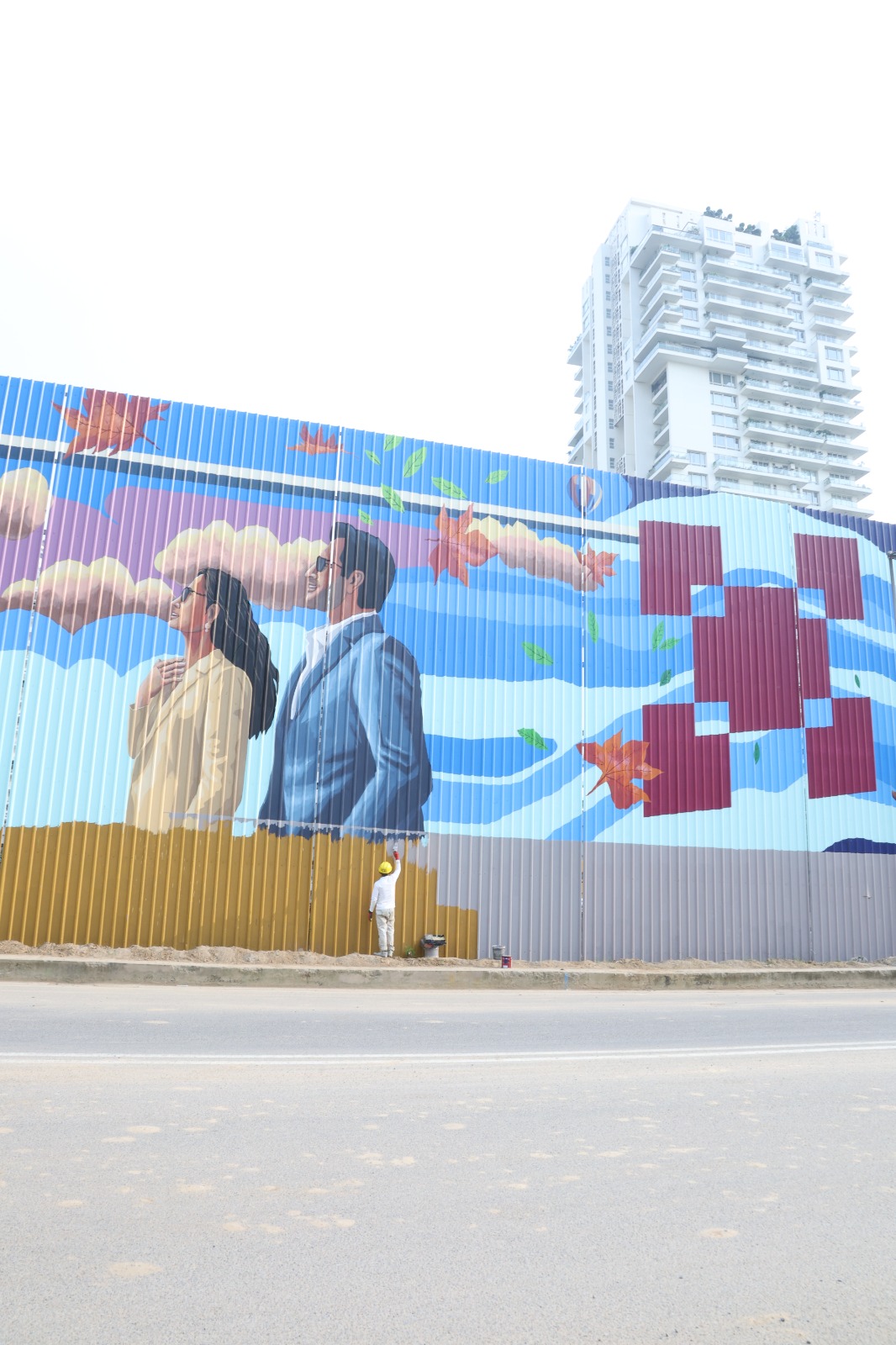
The intervention began with a simple idea: could a temporary part of a construction site contribute something to the city rather than simply advertise what was being built behind it?*
Construction sites occupy a significant visual presence in rapidly developing neighbourhoods. Their boundaries can remain part of the streetscape for years. Here, instead of treating that frontage purely as branding inventory, the barricading has been turned over to art.
For Sayan Mukherjee, the unusual setting and scale were central to the opportunity.
Sayan Mukherjee says,
> “We’re so used to seeing construction barricades used for branding. When I was presented with this opportunity, I thought it could be a place to do something different — something that people could actually engage with. The scale also allows the work to reveal itself gradually as people move along it.”
The project comes at a time when public art is increasingly moving beyond galleries and designated cultural spaces and becoming part of the everyday fabric of Indian cities.
Delhi’s Lodhi Art District is among the country’s best-known examples, while Mumbai and Kolkata have also seen walls, streets and neighbourhood spaces increasingly used as canvases for public art.
The Gurugram intervention sits within that broader conversation, but in a distinctly different setting: *the edge of an active construction site on one of the city’s rapidly evolving residential and commercial corridors.
There is also something inherently temporary about the canvas. The barricading exists because something is being built behind it; eventually, both the construction site and the artwork will change. For the period that it remains, however, a functional boundary has become part of the visual experience of the neighbourhood around it.
The fact that the mural is still being painted adds another dimension. Passers-by are not simply encountering a completed artwork. They are watching it evolve — section by section, over time.
And with much of the mural still underway, there is more of the canvas yet to be seen.