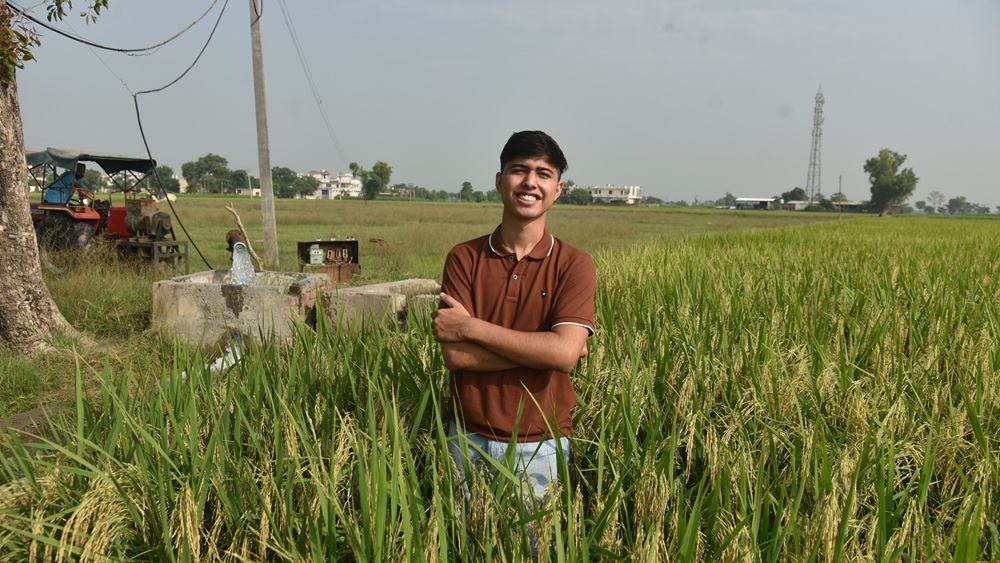
Punjab, Sep 04: For 18-year-old Shivansh Sarin, agricultural residue was never just waste. Growing up in Amritsar, surrounded by farming communities, he saw a problem that has become a familiar part of India’s environmental conversation: farmers burning crop residue because it is the quickest and most affordable way to clear their fields.
The consequences, he realised, go far beyond the fields.
“Crop-residue burning contributes to air pollution and greenhouse gas emissions, while repeated burning can also affect soil quality. Yet for farmers with limited affordable alternatives, simply burning the residue remains the most practical option”, said Shivansh.
Instead of accepting that as the status quo, Shivansh decided to explore whether the same agricultural waste could be turned into something valuable.
His school-level prototype, which is now ready, demonstrated the generation of electricity from agricultural residue using thermoelectric generators. He now wants to take the concept much further through AgriVolt Carbon Al, his idea among the Top 40 candidates of Samsung’s flagship CSR programme Samsung Solve for Tomorrow.
The proposed solution combines sensors and Artificial Intelligence, including Reinforcement Learning, to optimise the processing of agricultural residue. The aim is to maximise the recovery of electricity and biochar, while also exploring the production of carbon-rich materials that could eventually have applications such as activated carbon or carbon black.
At its heart, Shivansh’s idea is about changing the equation around agricultural waste: from something farmers need to get rid of into a resource that can potentially generate energy and create economic value.
A problem he saw beyond the headlines
The idea began with something Shivansh was seeing repeatedly in the news.
“Every year we see air pollution. News channels show how agricultural waste burning is contributing to it. But it is not just one place — it is a common problem across the country,” he said.
His research took him beyond headlines and into villages around Amritsar. He met village heads and spoke to communities to understand whether a solution such as his could work on the ground.
The response gave him confidence that the problem was worth pursuing.
Farmers, he says, were receptive to the idea of a young person from their own state working on a problem that directly affects their communities.
For Shivansh, those conversations also changed the nature of the project. It was no longer simply a science experiment built in school. It became an attempt to understand how technology could be designed around a real-world need.
Turning a school experiment into a larger ambition
The next challenge is scale.
Shivansh envisions AgriVolt Carbon Al as a system that can use real-time sensor data and AI-based optimisation to make the processing of agricultural residue more efficient. The larger goal is to create a circular approach in which crop waste can generate useful outputs rather than being treated as something with no value.
Electricity could provide one benefit. Biochar and other carbon-rich materials could provide another, with potential applications in future carbon-based products.
For Shivansh, the environmental case and the economic case are closely connected.
“If farmers are burning agricultural waste, they are also affecting the fertility of their soil. I want my idea to help with both — the environment and the farmers,” he says.
That ambition reflects a broader shift among young innovators: looking beyond technology for technology’s sake and using skills in AI, electronics and engineering to tackle problems that affect communities around them.
Shivansh’s journey began with a school prototype. His larger ambition is to develop it into something that could offer farmers an affordable alternative to burning agricultural residue — while converting a persistent environmental problem into a potential source of energy and value.
For a teenager from a city surrounded by farms, it is also a reminder that innovation does not always begin in a large technology company.
Sometimes, it begins by looking at a problem happening in your own backyard and asking a simple question: what if this could be done differently?