
The education industry is undergoing one of the most significant transformations in its history. Traditional classrooms, conventional teaching methods, and standardised learning systems are gradually evolving into technology-driven, personalised, and accessible learning environments. At the centre of this transformation is Artificial Intelligence (AI), a powerful technology that is reshaping how students learn, how teachers teach, and how educational institutions operate.
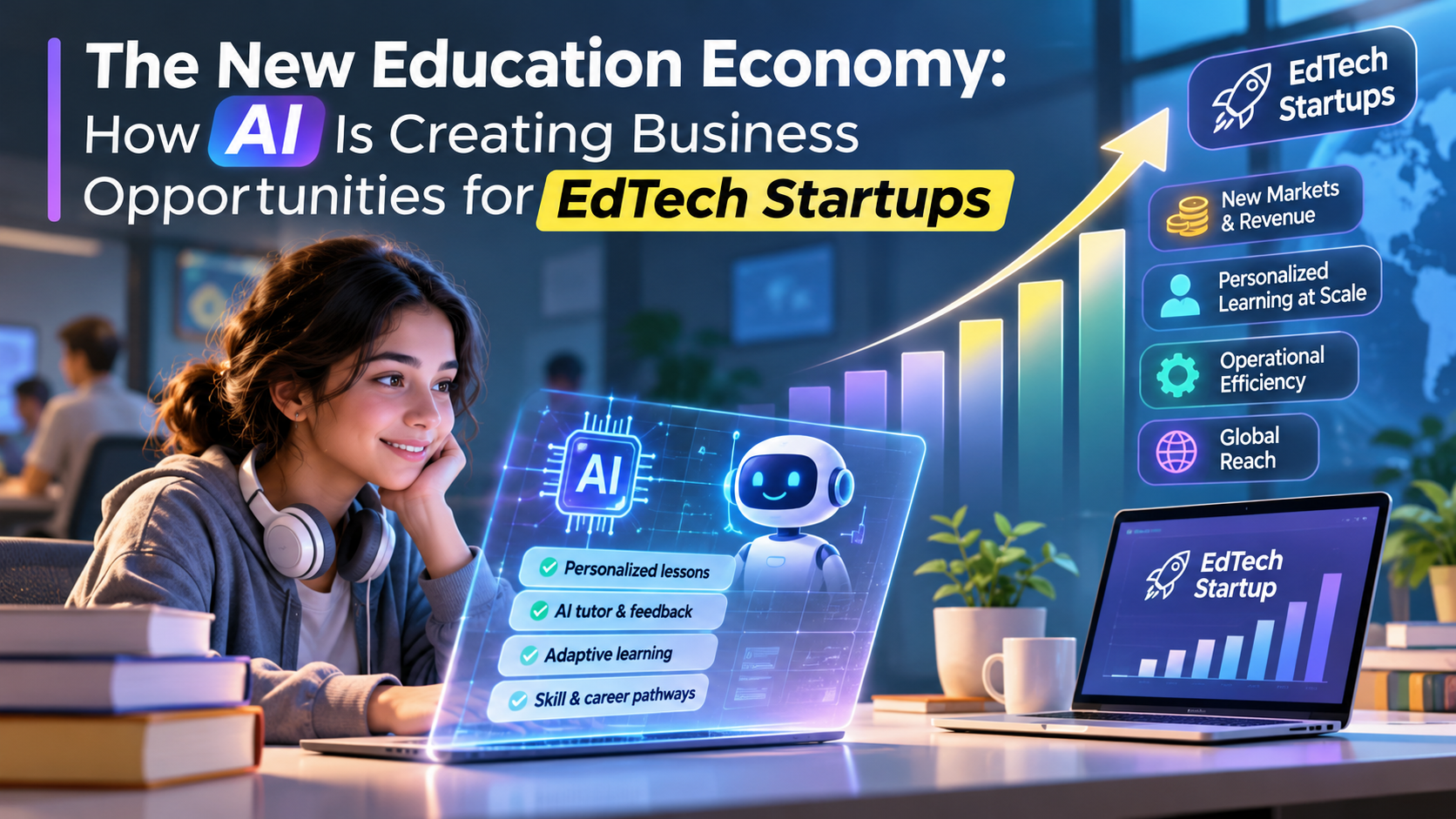
The emergence of AI is not just changing the education system; it is creating an entirely new education economy. From AI-powered tutoring platforms and personalised learning applications to automated assessment tools and intelligent learning management systems, AI is opening new business opportunities for entrepreneurs and EdTech startups.
As demand for flexible, affordable, and personalised education continues to grow, startups have an opportunity to develop innovative solutions that address real educational challenges. The combination of AI, digital infrastructure, and changing learner expectations is creating a promising environment for the next generation of EdTech businesses.
The Rise of the New Education Economy
The new education economy represents a shift from traditional, classroom-centred education towards a more flexible, digital, and technology-enabled learning ecosystem.
In the traditional education model, students generally follow the same curriculum, learning schedule, and teaching approach. However, every learner has different abilities, interests, learning speeds, and educational goals. AI makes it possible to address these differences through personalised learning experiences.
Modern AI-powered education platforms can analyse student performance, identify knowledge gaps, recommend learning materials, and adjust content according to individual needs.
This transformation is creating opportunities across several segments, including:
-
Online learning and digital education platforms.
-
Personalised AI tutoring systems.
-
Automated examination and assessment solutions.
-
AI-powered educational content creation.
-
Language learning and communication tools.
-
Corporate training and professional development.
-
Specialised learning solutions for students with different educational needs.
For EdTech startups, these developments represent opportunities to build scalable businesses while addressing important challenges in education.
AI-Powered Personalised Learning: A Major Business Opportunity
One of the biggest limitations of traditional education is the lack of individual attention. In a classroom with dozens of students, teachers often struggle to provide personalised guidance to everyone.
AI is changing this situation by enabling adaptive learning systems.
These platforms can understand a student’s learning patterns, evaluate performance, and provide customised lessons, exercises, and recommendations. If a student struggles with mathematics, for example, an AI-powered platform can identify the specific concepts causing difficulty and suggest additional explanations and practice questions.
This creates an opportunity for startups to develop intelligent learning applications that offer:
-
Personalised study plans.
-
AI-generated practice exercises.
-
Real-time feedback.
-
Individual learning progress reports.
-
Adaptive lessons based on student performance.
Such solutions can serve school students, college learners, competitive examination candidates, and working professionals.
Startups can generate revenue through monthly subscriptions, premium learning packages, institutional licensing, and partnerships with educational organisations.
AI Tutors: Bringing Personalised Education to Everyone
AI-powered tutoring is emerging as one of the most promising areas of the EdTech industry.
Traditional private tutoring can be expensive and geographically limited. AI tutors can make learning support more accessible by providing students with explanations, practice questions, and instant feedback whenever they need assistance.
Unlike conventional educational videos, interactive AI tutors can respond to questions, explain difficult concepts in different ways, and guide learners through problems step by step.
For example, a student preparing for competitive examinations can use an AI tutor to practise questions, understand incorrect answers, revise important topics, and develop a personalised study schedule.
EdTech startups can build specialised AI tutoring solutions for:
-
School-level mathematics and science.
-
Competitive examinations.
-
English-speaking and language development.
-
Coding and technical education.
-
Higher education and professional certifications.
A particularly attractive opportunity lies in developing subject-specific AI tutors rather than generic chatbots. These products can offer curriculum-aligned content, reliable explanations, and measurable learning outcomes.
AI-Driven Content Creation: Reducing the Cost of Education
Creating high-quality educational content requires significant time, expertise, and financial investment. Teachers and educational institutions often need to prepare presentations, assignments, quizzes, study notes, question banks, and learning materials.
Generative AI is making this process faster and more efficient.
AI tools can help educators generate lesson plans, summarise complex topics, create practice tests, develop interactive learning materials, and translate educational content into different languages.
This creates an opportunity for startups to develop AI-powered content creation platforms specifically designed for education.
Potential products include:
-
Automated question paper generators.
-
AI-based lesson planning software.
-
Educational video and presentation creators.
-
Multilingual learning content generators.
-
AI-powered notes and study guide applications.
-
Curriculum-based worksheet generators.
For startups, the business model could include subscription-based software, pay-per-use services, and enterprise solutions for schools, colleges, coaching centres, and publishers.
Opportunities in India’s EdTech Market
India presents significant opportunities for AI-driven educational innovation because of its large student population, growing digital adoption, diverse languages, and demand for affordable learning solutions.
Although access to quality education has improved, several challenges remain. These include differences in educational resources between urban and rural areas, shortages of individual academic support, language barriers, and unequal access to specialised learning opportunities.
AI-powered EdTech startups can help address these challenges through solutions designed specifically for Indian learners.
Some promising business opportunities include:
Regional-language learning platforms: Developing AI tutors and educational applications in languages such as Hindi, Odia, Bengali, Tamil, Telugu, and other regional languages.
Competitive examination preparation: Building intelligent learning platforms for examinations such as JEE, NEET, UPSC, banking, and other government recruitment examinations.
Affordable digital tutoring: Offering personalised academic assistance at a lower cost than traditional private tutoring.
Rural education technology: Developing lightweight applications that support low-bandwidth environments and make educational resources more accessible.
Skill development platforms: Providing AI-powered training in coding, digital marketing, communication, data analytics, and other employment-oriented skills.
Startups that understand local educational requirements and develop solutions around affordability, accessibility, and language diversity may find meaningful opportunities in this market.
AI-Powered Automation: Transforming Institutional Management and Operations
Artificial Intelligence is transforming not only the way students learn but also how educational institutions manage their day-to-day operations. Schools, colleges, universities, and coaching institutes handle numerous administrative responsibilities, including student admissions, attendance tracking, examination management, academic reporting, and parent communication. Managing these repetitive processes manually can consume significant time and resources.
AI-powered automation offers an opportunity to streamline institutional operations, reduce administrative workloads, and improve overall efficiency. Intelligent systems can automate attendance tracking, manage admission enquiries, provide AI-driven student support, evaluate objective assessments, analyse academic performance, process administrative documents, and facilitate parent-teacher communication.
This growing demand for operational efficiency creates a promising business opportunity for EdTech startups. By developing AI-powered Software-as-a-Service (SaaS) solutions, startups can offer educational institutions integrated platforms that simplify administration, improve decision-making, and enhance communication. Subscription-based pricing models also provide startups with the potential to generate recurring revenue while building long-term partnerships with schools, colleges, universities, and coaching institutes.
New Business Models for AI-Based EdTech Startups
AI is also changing how educational businesses generate revenue. Startups no longer need to depend entirely on one-time course sales or traditional subscription models.
Several business models are emerging:
1. Subscription-based learning: Students pay monthly or annually to access AI tutoring, personalised study plans, and learning resources.
2. Freemium platforms: Basic educational services are available for free, while advanced AI features are offered through paid plans.
3. B2B SaaS solutions: Schools, colleges, and coaching institutions pay recurring fees to use AI-powered educational software.
4. AI-powered learning marketplaces: Platforms connect students with educators, tutors, mentors, and specialised learning resources.
5. Corporate learning solutions: Businesses purchase AI-powered training platforms to improve employee skills and productivity.
6. White-label educational technology: Startups develop AI-powered platforms that other educational brands can customise and operate under their own identity.
The best business model depends on the target audience, product value, operating costs, and the willingness of customers to pay.
Challenges and Risks Startups Must Consider
Despite its enormous potential, AI in education also presents challenges that startups must address responsibly.
Data privacy and security: Educational platforms collect sensitive information about students, including their academic performance and learning behaviour. Protecting this data must be a priority.
Accuracy and reliability: AI systems can generate incorrect information or misleading explanations. Educational products need quality controls, verified learning materials, and appropriate human oversight.
Digital accessibility: Not every student has access to high-speed internet, modern devices, or reliable digital infrastructure. Startups should consider affordable and low-bandwidth solutions.
Academic integrity: AI tools may be misused for plagiarism, cheating, or completing assignments without genuine learning. Responsible product design should encourage understanding rather than simply providing answers.
Human interaction: AI should support teachers, not eliminate the importance of human guidance, mentorship, and emotional understanding.
Regulatory compliance: Startups must consider applicable data protection, child safety, education, and consumer protection requirements in the markets where they operate.
Businesses that build trust, transparency, and educational quality into their products will be better positioned for long-term growth.
The Future of AI and EdTech Entrepreneurship
The future of education is likely to involve closer collaboration between artificial intelligence, educators, educational institutions, and learners.
AI will increasingly become an integral part of everyday learning. Students may use intelligent assistants for academic guidance, teachers may use AI to prepare personalised lessons, and institutions may rely on predictive analytics to identify students who need additional support.
Emerging technologies such as generative AI, voice-based learning, multimodal AI, and intelligent learning analytics will create further opportunities for innovation.
For entrepreneurs, the biggest opportunity will not simply be building another online learning application. It will be creating solutions that deliver measurable improvements in learning outcomes, reduce educational costs, and make quality education more accessible.
Startups that combine strong educational expertise with responsible AI development can establish sustainable businesses in this evolving market.
Conclusion
The new education economy is creating a powerful intersection between technology, entrepreneurship, and learning. Artificial Intelligence is transforming traditional educational processes while opening new opportunities for startups to develop innovative products and services.
From personalised AI tutors and automated content creation to institutional management software and regional-language learning platforms, the possibilities are extensive.
However, success in the EdTech industry will depend on more than technological innovation. Startups must understand the real needs of students, teachers, parents, and educational institutions. They must prioritise accuracy, affordability, accessibility, privacy, and measurable learning outcomes.
The future belongs to businesses that use AI not merely to automate education but to make learning more effective, inclusive, and accessible.